

As Discovery Dies, So Does Perspective
Kraftisms #21 - AI answers are efficient. They’re also making us dumber.

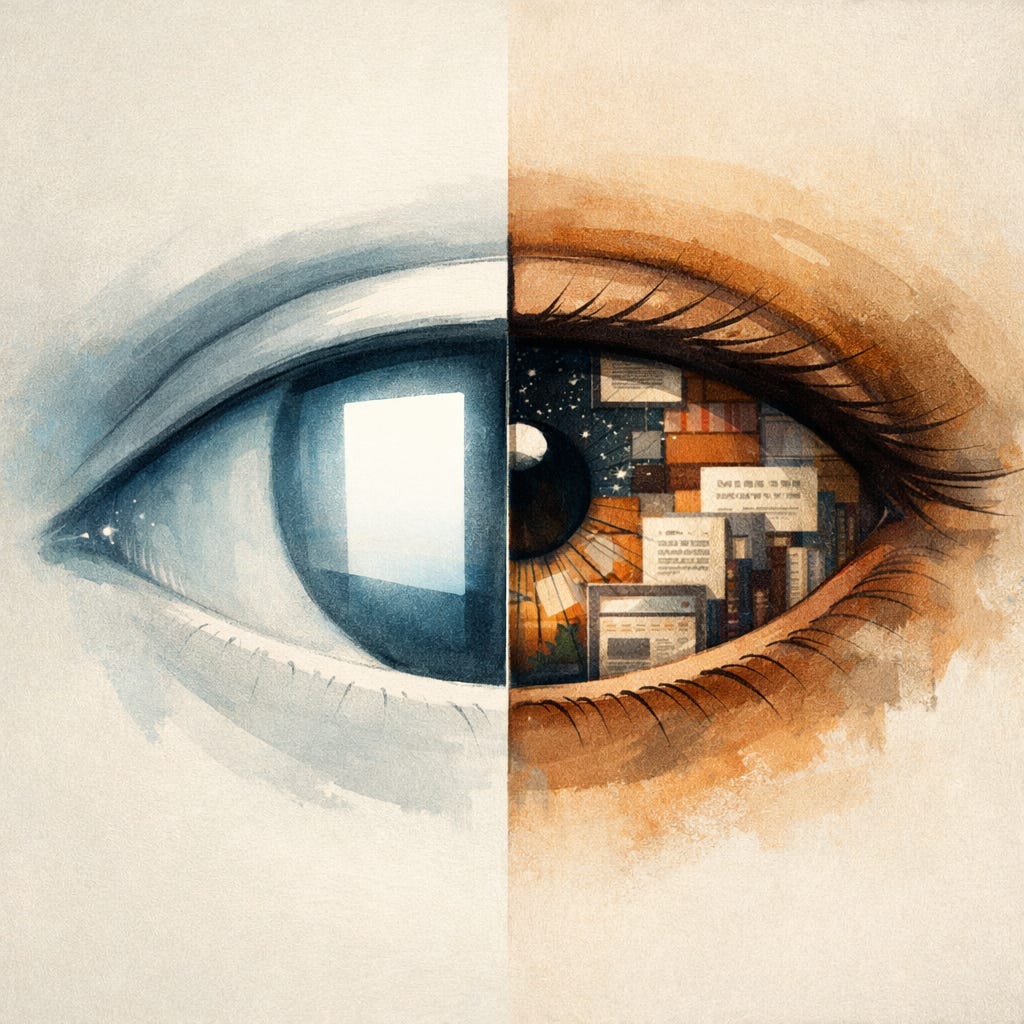
Quote(s) of the Week
“I have no special talents. I am only passionately curious.” -Albert Einstein
“Nine times seven is sixty-three, and I don’t need a computer to tell me so. The computer is in my own head. And it was amazing the feeling of power that gave him.” -Isaac Asimov, “The Feeling of Power” (and yes, the character got the math wrong)
Kraftism of the Week: A Story About Discovery
I wasn’t looking for anything in particular. That was the point.
I had been grinding through business books for months. Leadership frameworks. Growth strategies. The usual. When I needed escape, I read space operas. Easy, familiar, comfortable. But one afternoon in a bookstore, I decided I wanted something different. Not useful. Not entertaining. Just… different.
I wandered into the science fiction section and pulled a random collection of Asimov short stories off the shelf. I flipped to a story I’d never heard of: “The Feeling of Power.”
The premise floored me. In a distant future, humans have become so dependent on computers that they’ve forgotten how to do basic arithmetic. A low-grade technician reverse-engineers the lost skill of pencil-and-paper math by studying ancient machines. The military immediately sees an application: if humans can calculate, they can replace the computers guiding weapons systems. Computers are expensive and hard to manufacture. Humans are cheap and abundant. The military’s conclusion is chilling in its efficiency: manned missiles with human pilots are more cost-effective than computer-guided ones, because people are more expendable than machines. The story ends with a man doing simple multiplication in his head (and getting it wrong), marveling at the feeling of power it gives him. The power of knowing something himself, even as that knowledge is being weaponized around him.
I didn’t find that story because an algorithm thought I’d like it. I found it because I was wandering. Because I was open to being surprised. Because I let myself stumble into something I didn’t know I was missing.
That story has shaped how I think about learning ever since. Every time technology promises to make us more efficient, I ask: what are we forgetting how to do?
Applying the Kraftism: The Collapse of Cognitive Parallax
Fancy words. But a great concept.
Here’s why everyone in advertising should care about what I’m about to say: the open web is one of the few remaining places where discovery still happens at scale. And discovery is the only mechanism humans have for developing the perspective to know when an answer is right or wrong. If the open web dies, so does something essential about how humans think. This isn’t just a publishing problem. It’s a civilization problem.
Yes, I know that sounds dramatic. Bear with me here, and I’ll make the case.
First, let me explain what I mean by discovery.
In astronomy, there’s a concept called parallax. When you view an object from two different positions, it appears to shift against the background. That shift, that difference in perspective, is how we calculate distance. It’s how we build a three-dimensional understanding of the universe. Without parallax, everything looks flat. You can’t tell what’s close and what’s far. You can’t triangulate.
Discovery is cognitive parallax.
When you read a newspaper and a story continued on page 8 right next to something unexpected, you got parallax. When you browsed a magazine rack and picked up something outside your usual interests, you got parallax. When early search engines returned messy results with links to adjacent but different topics, you got parallax.
Each of those experiences gave you a second vantage point. A view you didn’t ask for. And that second view is what lets you triangulate: to judge distance, to spot errors, to develop perspective.
Now think about what we’ve built.
Algorithmic feeds show you content optimized for engagement, which means content you already like. AI answer systems give you the answer, not a set of possibilities to explore. Everything is efficient. Everything is relevant. And everything is flat.
Without discovery, you lose perspective. Without perspective, you don’t know what to question. When an AI gives you an answer, how do you know if it’s right? If you’ve never been exposed to adjacent ideas, contradictory viewpoints, or unexpected context, you have no second vantage point. No parallax. No depth perception.
Why It’s Getting Worse
The problem isn’t just AI. It’s that our entire information environment has become hostile to sense-making.
Modern systems optimize for legibility, not understanding. Dashboards, feeds, rankings, AI summaries: they favor inputs that are easy to measure and act on, even if they distort reality. What gets lost is the slow, messy synthesis that humans use to test whether something actually makes sense.
Speed has quietly replaced wisdom as a cultural virtue. Fast answers feel empowering. But they remove the pause where doubt, comparison, and judgment happen. Over time, we lose the muscle for holding multiple hypotheses at once. AI satisfies our addiction to speed while eroding our capacity for discernment.
And here’s the uncomfortable part: most people aren’t even seeking parallax. Curiosity can be socially dangerous. Asking “why” too often signals dissent or ignorance. Algorithms reward conformity. So people trade depth for belonging, often without realizing it.
And before that leads you to think otherwise, let me be clear: I’m not anti-AI. I use it every single day in multiple ways. I have pre-written prompts for various tasks ranging up to twenty pages in length or more. But I also don’t treat AI as the be-all-end-all. I need to seek my discovery elsewhere, as well. And that’s when I look to the web (yes, really!).
The Open Web as the Last Bastion
This is where publishers, adtech, and advertisers come in. Because we create, power, and fund the open web.
Discovery doesn’t happen inside walled gardens. It happens when you click a link to a niche hobbyist blog and end up reading about something you never knew existed. It happens on recipe sites and how-to guides written by passionate experts. It happens in local news, passion-project newsletters (oh, like this one!), and forums run by people who just want to teach.
These small sites, the weird corners of the open web, are the last places where serendipity still lives.
But they’re disappearing. Traffic is consolidating. AI is scraping their content and serving it without attribution. Advertising economics make it harder for small publishers to survive. And the platforms that could support discovery, the aggregators and curation tools, mostly optimize for engagement instead of exploration.
This matters beyond economics. If the open web dies, so does the infrastructure for human curiosity. We’ll be left with efficient answers and no way to know if they’re true.
To Wrap It All Up
Asimov understood something important. In “The Feeling of Power,” the tragedy isn’t that humans forgot how to do math. It’s that they forgot they ever could. They became dependent on systems they no longer understood, and they lost something essential about themselves.
Discovery is like that. It’s not inefficiency. It’s the mechanism by which we develop perspective. When we let systems eliminate the friction of exploration, we don’t just save time. We quietly remove the conditions required for curiosity, skepticism, and judgment.
So here’s what I’d ask of you.
When you use AI, don’t just take the answer. Ask it what else you should know. Ask for the adjacent idea, the contradictory view, the context you didn’t think to request.
When you browse the web, wander. Click the link that doesn’t seem relevant. Visit the site that isn’t optimized for you - and read more than one story.
And if you’re in this industry, fight for the open web. Not just because it’s good for business, but because, without the open web, we lose the last places where humans can still stumble into something they didn’t know they were missing.
That’s where the feeling of power actually lives.
Andrew